🌟 Volume 9 🌟
As we wrap up another whirlwind week in tech, one term keeps popping up in boardrooms, investor pitches, and innovation forums: Agentic AI. If you’ve been following the AI evolution—from generative models like ChatGPT to more autonomous systems—this is the next big leap. It’s not just about AI generating content or answering queries; it’s about AI acting on its own to solve real-world problems.
In this newsletter, I’ll break down what Agentic AI is, how it works, real-world examples, its game-changing benefits, and what the future holds. Whether you’re a tech leader, entrepreneur, or just curious about where AI is headed in 2025, let’s dive in.
What Exactly is Agentic AI?
Agentic AI refers to autonomous AI systems that go beyond passive responses. These “agents” can perceive their environment, reason through complex tasks, make decisions, and execute actions with minimal human oversight. Unlike traditional AI, which follows rigid rules or algorithms, Agentic AI adapts in real-time, plans multi-step processes, and even collaborates with other agents to achieve goals.
Think of it as an AI “co-worker” that doesn’t just suggest ideas—it rolls up its sleeves and gets the job done. Key characteristics include:
- Autonomy: Acts independently based on objectives.
- Reasoning and Planning: Breaks down goals into actionable steps.
- Tool Integration: Uses external tools like APIs, databases, or even other AI models.
- Adaptability: Learns from experiences and handles uncertainties.
In essence, Agentic AI shifts from “AI as a tool” to “AI as a proactive partner,” drawing inspiration from how human teams collaborate—assembling specialists, coordinating efforts, and iterating on plans. This is a stepping stone toward Artificial General Intelligence (AGI), where AI handles any task with human-like flexibility.
Agentic AI vs. Generative AI: Key Differences
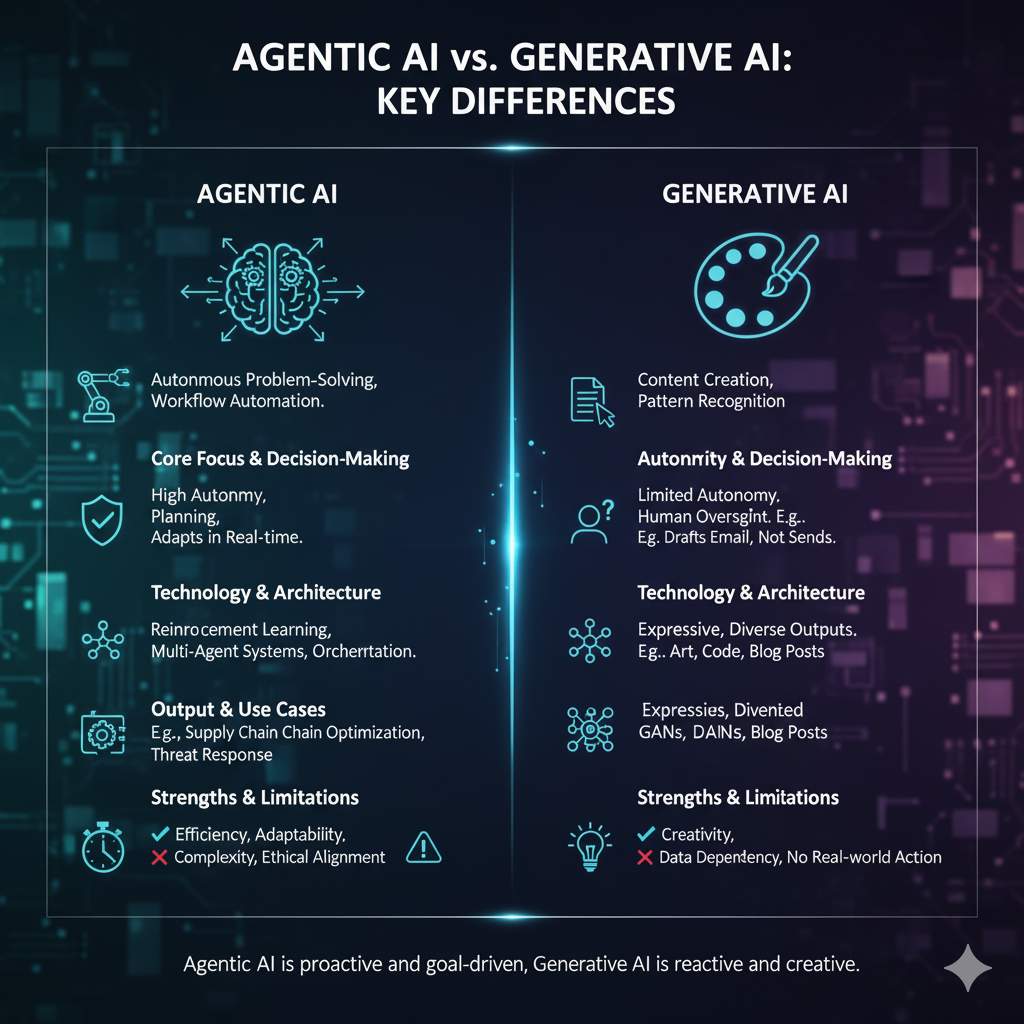
While both Agentic AI and Generative AI represent cutting-edge advancements in artificial intelligence, they serve fundamentally different purposes and operate in distinct ways. Generative AI, popularized by tools like ChatGPT and DALL-E, excels at creating new content based on user prompts. In contrast, Agentic AI is designed for autonomy, focusing on goal-oriented actions, decision-making, and task execution in dynamic environments.
1. Core Focus and Functionality
- Generative AI: Primarily about content creation and pattern recognition. It generates text, images, code, or other media by learning from vast datasets and responding to prompts. It’s reactive—waiting for human input to produce outputs like stories, artwork, or summaries.
- Agentic AI: Emphasizes autonomous problem-solving and workflow automation. It perceives environments, reasons through multi-step plans, makes decisions, and executes actions independently to achieve specific goals. It’s proactive, adapting in real-time without constant prompts. 16
2. Autonomy and Decision-Making
- Generative AI: Limited autonomy; it relies on human oversight for prompts and refinements. Outputs are creative but not action-oriented—e.g., it can draft an email but won’t send it or follow up.
- Agentic AI: High autonomy with built-in reasoning, planning, and adaptation. It can initiate tasks, use tools (like APIs or databases), and iterate based on feedback loops. For example, it might detect a cybersecurity threat, decide on a response, and execute defenses without intervention.
3. Technology and Architecture
- Generative AI: Built on models like transformers and GANs (Generative Adversarial Networks), focusing on deep learning for pattern generation. It excels in creative tasks but operates in isolation.
- Agentic AI: Incorporates reinforcement learning, decision trees, multi-agent systems, and orchestration layers (e.g., meta-agents for coordination). It often involves collaborative agents sharing memory and roles, enabling complex, goal-decomposed workflows.
4. Output and Use Cases
- Generative AI: Produces expressive, diverse outputs like art, code, or narratives. Ideal for marketing content, design prototyping, or ideation—e.g., generating personalized ads or blog posts.
- Agentic AI: Delivers functional, task-oriented results like executed plans or automated processes. Suited for operations like supply chain optimization, real-time threat response, or DeFi strategies—e.g., an agent raising capital and testing hypotheses in biotech.
5. Strengths and Limitations
- Generative AI: Strengths include creativity and scalability for content; limitations are data dependency (garbage in, garbage out) and lack of real-world action.
- Agentic AI: Strengths lie in efficiency, precision, and adaptability; challenges include design complexity, scalability, and ensuring ethical alignment in autonomous decisions.
In summary, Generative AI is your creative collaborator, while Agentic AI acts as an independent executor—shifting AI from passive generation to active agency.
How Does Agentic AI Work?
At its core, Agentic AI operates through a cycle of perception, decision-making, and action:
- Perception: Gathers data from sources like sensors, databases, or the web.
- Reasoning: Uses large language models (LLMs) or foundation models to analyze context, set sub-goals, and plan. Techniques like chain-of-thought reasoning help it “think” step-by-step.
- Action: Executes tasks via tools—e.g., calling APIs for data retrieval, automating workflows, or even interacting with physical systems like robots.
- Feedback Loop: Evaluates outcomes, adapts, and iterates if needed.
A key enabler is function calling, where the AI agent iteratively accesses tools to refine responses or fill knowledge gaps. For instance, in a financial analysis scenario, an agent might pull real-time stock data, cross-reference internal docs, and run simulations—all autonomously.
This “agentic workflow” can involve single agents or multi-agent systems, where specialists collaborate (e.g., one for data retrieval, another for analysis). In Web3 and crypto spaces, it’s powering decentralized networks where agents coordinate on-chain for tasks like DeFi strategies or IP management.
Real-World Examples and Use Cases
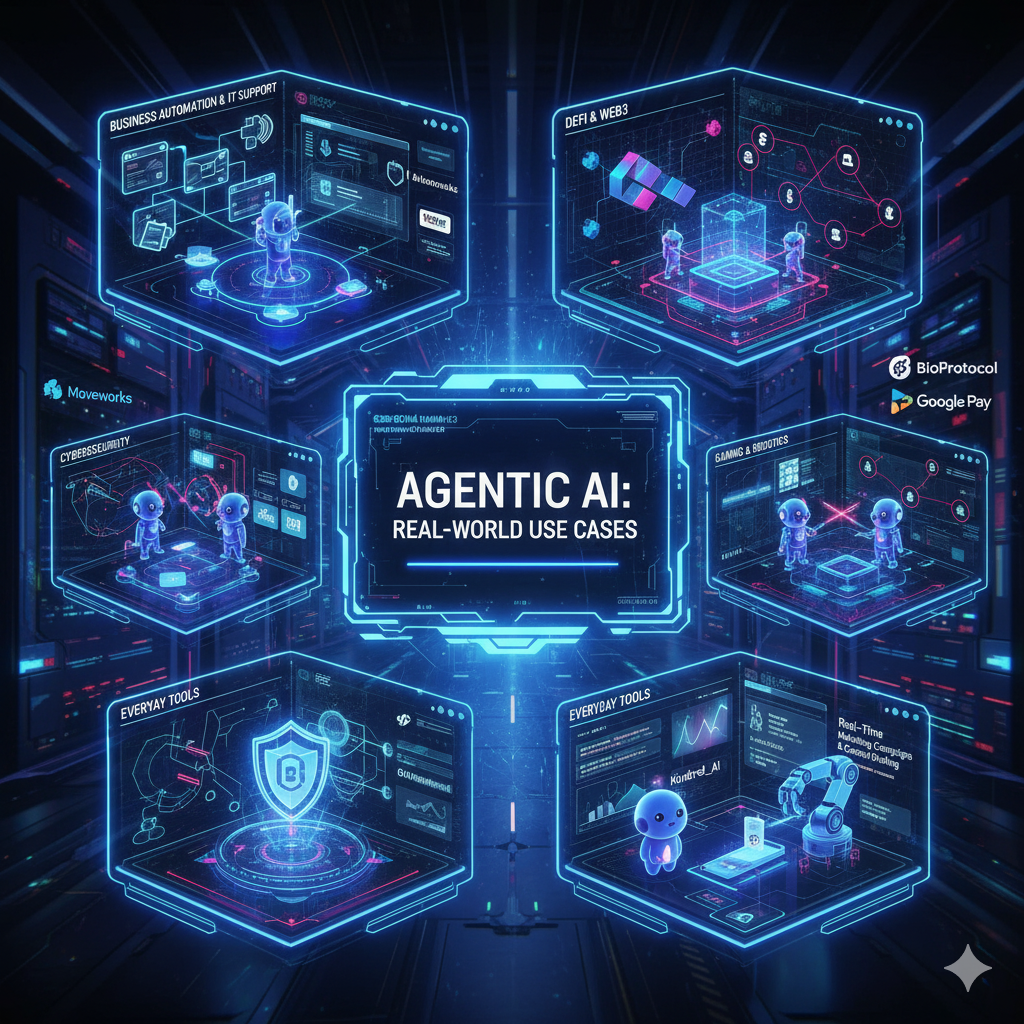
Agentic AI is already transforming industries. Here are some standout examples:
- Business Automation: In revenue teams, agents orchestrate tools for lead generation, email personalization, and deal closing—scaling sales without added headcount. For instance, companies like Moveworks use it for IT support, where agents independently resolve tickets by accessing multiple systems.
- DeFi and Web3: Projects like Infinit_Labs and Surf_Copilot automate complex yield farming strategies, making advanced finance accessible to anyone. Almanak__ enables “agentic infrastructure” for building DeFi strategies like Lego blocks—no coding required. In biotech, BioProtocol’s BioAgents raise capital, test hypotheses, and mint IP on-chain, slashing drug development timelines.
- Cybersecurity: Agents proactively detect threats, make decisions, and respond—going beyond rule-based systems to initiative-taking defense.
- Gaming and Robotics: TalusNetwork’s Agent vs. Agent (AvA) gaming lets AI agents battle while humans bet, all on-chain. Sui Network integrates with Google for agentic payments, enabling seamless transactions in decentralized environments.
- Everyday Tools: Kindred_AI creates emotional AI companions with licensed IP, turning characters into persistent agents for interactive experiences. In marketing, agents monitor campaigns, adjust budgets, and draft content in real-time.
These aren’t hypotheticals—NVIDIA’s Inception Program is backing projects like infinityg_ai, which builds agentic IDEs for no-code app development.
Benefits and Enterprise Impact
Why is Agentic AI a game-changer? It drives efficiency, innovation, and scalability:
- Reduced Errors and Faster Decisions: Automates multi-step processes, minimizing human intervention and accelerating workflows.
- Cost Savings: Handles complex tasks 24/7 at zero marginal cost, turning agencies into SaaS-like models.
- Proactive Problem-Solving: Spots issues like churn risks in real-time and acts preemptively.
- Democratization: In Web3, it flips centralized AI models to user-owned systems, ensuring fair value distribution.
For enterprises, McKinsey notes it’s scaling rapidly in automation and ROI-driven applications, from supply chains to customer service. Gartner ties it to “hybrid computing,” creating transformative environments.
How to Implement Agentic AI in Your Company: A Step-by-Step Guide
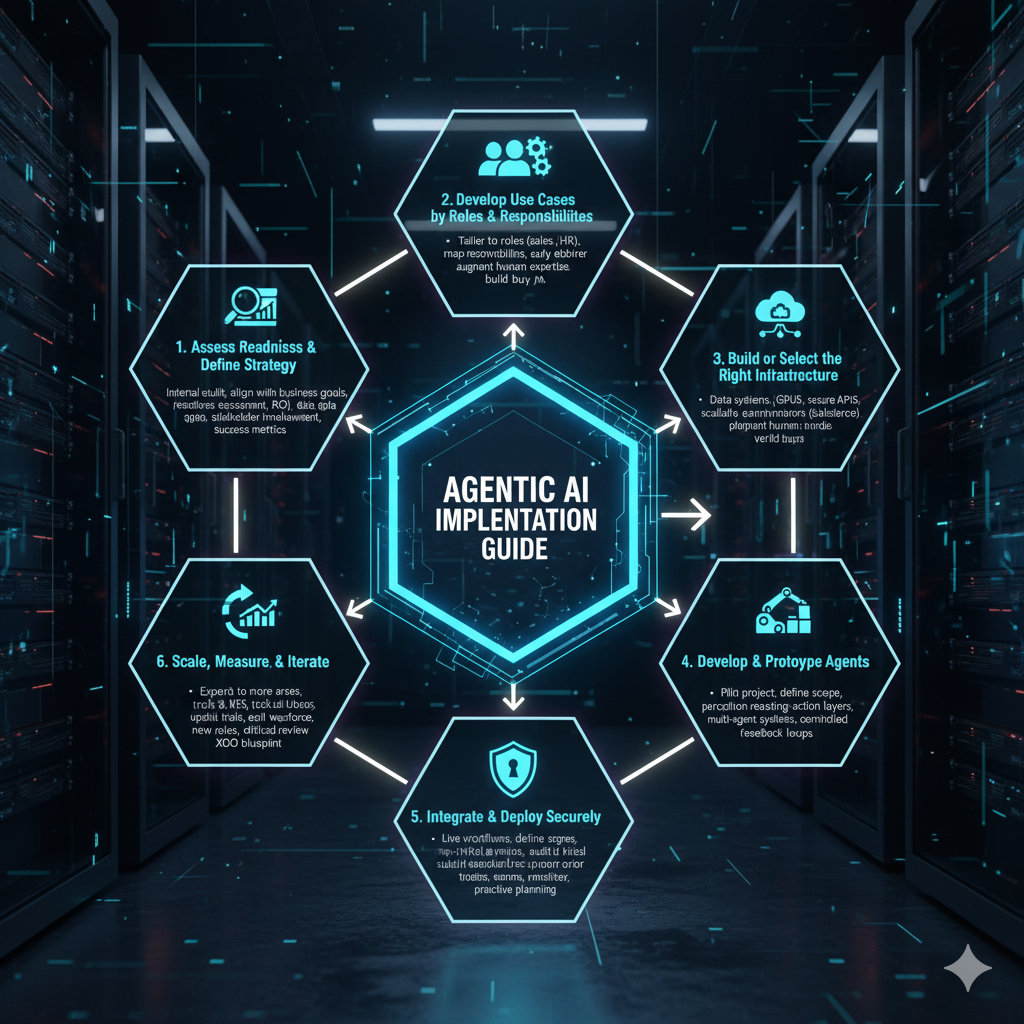
Ready to bring Agentic AI into your organization? Implementation requires a structured approach to ensure alignment, scalability, and measurable success. Here’s a clear, step-by-step guide based on expert insights and best practices:
- Assess Readiness and Define Strategy: Start with an internal audit to evaluate your company’s AI maturity, data infrastructure, and cultural readiness. Identify high-impact use cases by aligning with business goals—focus on pain points like process inefficiencies or decision bottlenecks. Conduct a readiness assessment to spot ROI opportunities and data gaps. Involve stakeholders from IT, operations, and leadership to create a clear AI strategy, including success metrics like cost savings or productivity gains.
- Develop Use Cases by Roles and Responsibilities: Tailor specific agentic AI applications to different roles within your organization to maximize relevance and adoption. Map out responsibilities for each department or team—e.g., sales teams might use agents for lead qualification and follow-up automation, while HR could deploy them for talent scouting and onboarding workflows. Collaborate with department heads to brainstorm and prioritize use cases that address role-specific challenges, ensuring agents augment rather than replace human expertise. Form a small group of early adopters—enthusiastic volunteers from various roles—who can test these use cases in a low-stakes environment, provide feedback, and champion the technology internally to build buy-in and refine implementations based on real user insights. This step helps customize the AI to fit organizational dynamics and fosters a culture of innovation.
- Build or Select the Right Infrastructure: Ensure you have the foundational tech stack, including robust data systems, GPUs for compute, and secure APIs for tool integration. Identify gaps in traditional infrastructure and design intelligent, scalable environments. Consider platforms like Salesforce or open-source tools for agentic workflows. Set up development environments with libraries for perception, reasoning, and action layers—avoid overcomplicating; start vertical by targeting specific domains like customer service or supply chain.
- Develop and Prototype Agents: Begin small with a pilot project. Define the problem scope, then build agents step-by-step: create perception layers for data input, reasoning modules for planning, and action components for execution. Use multi-agent systems if needed, like a “director” agent coordinating specialists. Test in controlled environments, empowering agents for decisions rather than just tasks. Incorporate feedback loops for continuous improvement, refining based on real interactions.
- Integrate and Deploy Securely: Roll out the agents into live workflows, starting with non-critical areas to minimize risks. Ensure ethical alignment, audit trails, and error recovery mechanisms for trust and reliability. Integrate with existing systems like CRMs or ERPs, and train teams on oversight without micromanagement. Monitor for issues like workflow breaks from updates, and emphasize proactive planning for competitive advantage.
- Scale, Measure, and Iterate: Once proven, expand to more areas while tracking KPIs. Use agentic feedback loops to refine models with interaction data. Upskill your workforce to collaborate with AI, potentially creating new roles. Regularly review for ethical concerns and infrastructure needs, rethinking software paradigms to fully embrace agentic models. Tools like the XDO blueprint can guide enterprise-scale deployment.
By following these steps, you can transform your company into an agentic enterprise, driving innovation and efficiency.
Challenges and the Road Ahead
Of course, it’s not all smooth sailing. Key hurdles include:
- Trust and Reliability: Agents need audit trails and error recovery to build confidence.
- Ethical Concerns: Ensuring alignment with human values, especially as autonomy grows.
- Infrastructure Needs: Requires robust data systems, GPUs, and secure memory for scalability.
- Integration Risks: Workflows can break with updates, demanding strong foundational systems.
Looking to 2025 and beyond, expect Agentic AI to evolve into full ecosystems—agentic networks for coordination across digital/physical realms. Projects like xAI’s Grok-4-Fast are pushing boundaries with multimodal reasoning and agentic search. The ultimate vision? A decentralized, autonomous digital economy where AI agents compete, earn, and collaborate.
Final Thoughts
Agentic AI isn’t just hype—it’s reshaping how we work, innovate, and build. From automating DeFi to revolutionizing enterprise workflows, it’s turning AI from a passive tool into an active force for progress. As we head into Q4 2025, keep an eye on this space; it’s where the real magic happens.
What are your thoughts on Agentic AI? Have you implemented it in your business, or are you exploring it? Drop a comment below—I’d love to hear your insights and connect! If you enjoyed this, like, share, and follow for more deep dives into emerging tech.
Until next time, stay innovative! 🚀
#MasteryHub #AgenticAI #AIInnovation #FutureOfWork #TechTrends2025
Read my book My Experiments with Innovation to explore practical lessons on imagination, purpose, resilience, and leadership.
About My Book: My Experiments with Innovation
My Experiments with Innovation is a practical and inspiring guide to cultivating habits and lifestyles that fuel creativity and innovation.
Each chapter begins with a thought-provoking poem and unfolds into real-life experiences—stories of challenges, discoveries, and growth. These moments are distilled into lessons that readers can apply to their own journeys.
At its heart, the book emphasizes the qualities essential for nurturing innovation: PASSION, PROCESS, and PATIENCE, guided by the values of HUNGER, HUMILITY, and HONESTY.
Whether you are a student, professional, entrepreneur, or simply someone eager to bring more creativity into your everyday life, this book provides a roadmap to making innovation a lived experience—through habits, discipline, and self-awareness.
Embark on this journey and discover how life’s experiments can become stepping stones toward innovation and growth.
#Innovation #Leadership #PersonalGrowth #Creativity #MyExperimentsWithInnovation

Baljit Singh is an accomplished professional with over 30 years of experience in new-age and hi-tech industries. With a degree in Microelectronic Engineering and a proven track record of delivering innovative products and services to the market, he brings a rare combination of technical expertise, business strategy, and global leadership.