The Decision Code: From Inner Clarity to Global Impact
By Baljit Singh
Preface
Every life is shaped by decisions.
Some pass quietly, almost unnoticed.
Others alter direction in ways that cannot be reversed.
Taken together, they define who we become.
Access to information has never been greater with Artificial Information, but on the other hand, Clarity has never been more scarce. We’ve built sophisticated systems to measure performance, efficiency, and growth. Yet we’ve overlooked something far more fundamental: the quality of the decisions that drive those outcomes.
This book starts with a simple but powerful premise:
The quality of your life is the quality of your decisions.
The book is inspired by the teachings of Bhai Gurdas Ji. If that holds true, then decision-making is not just a skill. It is a discipline. One that deserves structure, reflection, and continuous refinement.
Across individuals, institutions, and societies, the same pattern repeats. Outcomes are analyzed, successes are celebrated, failures are dissected. But in the journey of life the thinking behind decisions often goes unexamined. A good result can hide poor judgment. A bad result can obscure sound reasoning.
Without examining decisions, learning remains incomplete. And without learning, patterns repeat.
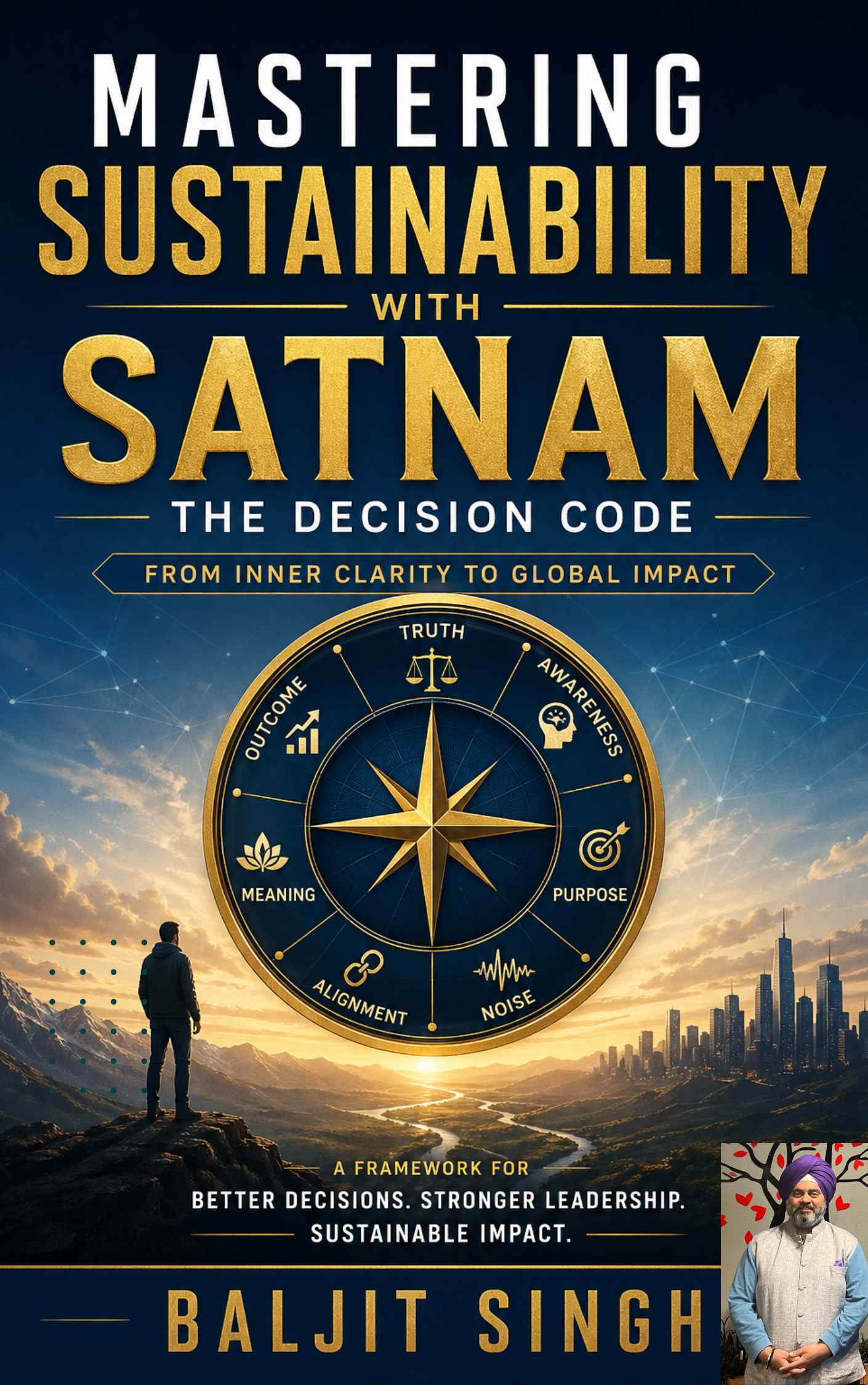
This book introduces SATNAM as a decision framework—a structured approach to thinking clearly, acting responsibly, and creating sustainable impact. It bridges inner clarity with external execution, connecting personal awareness with organizational effectiveness.
SATNAM is not just a model. It is a way of seeing, evaluating, and choosing in the journey of life consistently.
Because in the end, you do not control outcomes.
You control decisions.
And over time, your decisions create your outcomes.
Book Outline
PART I — THE FOUNDATION
Understanding the Problem Before Solving It
Chapter 1: The Crisis of Decision-Making
Modern decision-making operates under pressure, distraction, and incomplete understanding. This chapter challenges the assumption of rationality and exposes the gap between perceived and actual decision quality.
Chapter 2: Ancient Insight, Modern Relevance
Timeless wisdom meets contemporary complexity. The metaphor of life as an ocean highlights the role of perception and internal clarity in navigating uncertainty.
Chapter 3: The Hidden Cost of Bad Decisions
Not all consequences are immediate. This chapter explores how small, compromised decisions accumulate into systemic failure over time.
Chapter 4: The Missing Layer
Organizations have systems for everything—except decisions. This chapter identifies the structural gap that leads to inconsistency and instability.
PART II — THE SATNAM FRAMEWORK
A Structured Approach to Decision Excellence
Chapter 5: Truth
Grounding decisions in reality. Eliminating bias, assumption, and distortion.
Chapter 6: Awareness
Filtering signal from noise. Understanding what truly matters.
Chapter 7: Purpose
Distinguishing between fear-driven and purpose-driven decisions—and why it matters.
Chapter 8: Noise
Managing overload in a world of constant inputs. The discipline of focus.
Chapter 9: Alignment
Ensuring decisions are executable within real-world systems and constraints.
Chapter 10: Meaning
Expanding decision impact beyond self-interest to long-term, systemic value.
Chapter 11: Outcome
Understanding how repeated decisions shape patterns—and ultimately, results.
PART III — APPLICATION
From Concept to Practice
Chapter 12: The SATNAM Scorecard
A practical tool to evaluate decision quality across seven dimensions, transforming intuition into measurable insight.
Chapter 13: Organizational Implementation
Embedding SATNAM into leadership, governance, and culture to create accountability and consistency.
Chapter 14: Technology and Decision Intelligence
Leveraging systems and data to track decisions, analyze outcomes, and continuously improve.
Chapter 15: Case Studies
Real-world scenarios illustrating how decision quality directly impacts success or failure.
Chapter 16: Leadership in Complexity
Why the future belongs not to those who know the most, but to those who decide the best.
Chapter 17: The Inner Shift
True transformation begins within. External clarity is a reflection of internal alignment.
Conclusion
Every system, every organization, every life is shaped by decisions.
Not by chance.
Not by circumstance.
But by choices made by humans consciously or unconsciously over time.
When decisions are grounded in:
- Truth
- Awareness
- Purpose
- Alignment
They naturally lead to:
- Stability
- Growth
- Impact
Final Thought
You do not control outcomes.
You control decisions.
And over time,
your decisions will create your outcomes.
/
|
|